Using the insights from organic chemistry to understand asymmetries everywhere.
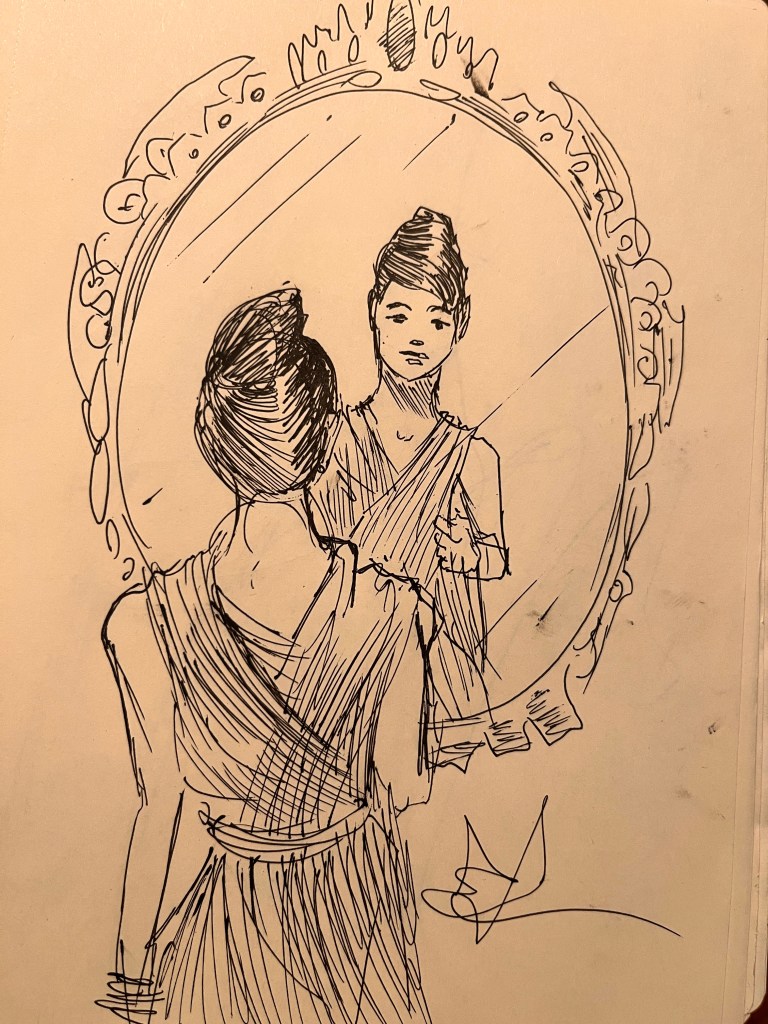
Asymmetries make the world interesting. They also arise spontaneously in the evolution of complex systems such as living beings. Asymmeties abound in organic biological molecules such as proteins, carbohydrates and the building blocks of DNA because carbon-based molecules share a property we are familiar with from the everyday world: they can exhibit handedness.
Hands come in two varieties, left and right. The property of handedness is properly called chirality (from the Greek word “cheir” (χείρ) which just means “hand”). While there are many everyday objects that are chiral, hands are the most immediate example. We know what it is to be righthanded or lefthanded, and many tools are built with a particular hand (typically the right hand) in mind. We can see that there is a difference between our left and right hands. They don’t overlap in space in a one-to-one manner. Stack your right hand on top of your left, palms down, and you’ll see that the thumbs point in opposite directions. Try to fix this by flipping one hand over, and now one hand is palm up and the other palm down. They can’t occupy the same space in the same way; they are non-superposable.
Another interesting feature of hands is that in a mirror image, a right hand is converted into a left hand, and vice versa. Chiral objects are not identical to their mirror image, but together they and their mirror image form a complete left-right pair. We can combine these observations into a complete definition of chirality: a chiral object is something that comes as a pair of non-superposable mirror images. A pair of chiral objects are called a pair of enantiomers.
Chirality is a mysterious thing. There doesn’t seem to be anything to be said about the property of righthandedness other than that it is the opposite of lefthandedness. But what does this difference consist of exactly? Other than that they are non-superposable mirror images, anything one could say about an idealized right hand could be equally said about its mirror image. The order of the fingers, the distance bewteen palm and thumb, any internal measurements would be the same. This mystery has caught the attention of philosophers over the years, and Immanuel Kant and Ludwig Wittgenstein have offered interesting takes on the subject.
It is only when a chiral object interacts with another chiral object that differences between left and right emerge. When we shake hands, we conventionally shake right hand to right hand. A left hand to left hand shake would be functionally equivalent. But try shaking right hand to left hand, and the grip becomes awkward. Left handed people, always in the minority, know that tools such as scissors or can openers (themselves chiral objects) are typically designed to fit into a right hand and are akward to operate lefthandedly. Borrowing a term from organic chemistry, we may call any system of objects made up of multiple chiral subunits diastereomers. In the simplest possible scheme, a system of two hands could exist as one of three diastereomers: right-left, right-right, or left-left. If the order matters, this number increases to four: right-left, left-right, right-right, and left-left.
We see diastereomers everywhere. In combat sports such as boxing or MMA, fighters assume a chiral stance that matches their handedness, ‘orthodox’ for righthanded fighters and ‘southpaw’ for lefthanded fighters. The dynamic between two orthodox fighters will be different than that between an orthodox and a southpaw. Unlike enantiomers, diastereomers have functional differences that can be described without needing to compare to a mirror image. These differences also exist on the molecular level of biology.
The philosopher Giovanni Villani has argued that chemistry is distinguished as the discipline in which systemic complexity is studied in its simplest form. The description of complex systems is incomplete without language that describes the asymmetries that interact with the design and function of these systems. Organic chemistry provides us with this language, and it is applicable to the entire world on every level.
 The Model Kit
Leave a comment